The vast, uncharted depths of the ocean have long posed a formidable challenge for navigation. Traditional GPS systems, which rely on satellite signals, become useless beneath the waves, leaving deep-sea explorers and autonomous underwater vehicles (AUVs) to rely on less precise methods. However, a groundbreaking solution is emerging from the realm of quantum physics: the quantum gyroscope. This cutting-edge technology promises to revolutionize underwater navigation, enabling precise positioning without the need for satellite signals.
The Limitations of Current Underwater Navigation
For decades, underwater navigation has depended on a combination of inertial navigation systems (INS) and acoustic positioning. INS uses accelerometers and mechanical gyroscopes to estimate position based on movement, but these systems accumulate errors over time, leading to significant drift. Acoustic methods, such as long baseline (LBL) or ultra-short baseline (USBL) systems, require pre-deployed transponders or surface support, limiting their practicality in remote or deep-sea environments. These constraints have hindered the deployment of autonomous deep-sea vehicles for extended missions.
Quantum Gyroscopes: A Paradigm Shift
Quantum gyroscopes leverage the strange and counterintuitive properties of quantum mechanics to measure rotation with unprecedented accuracy. Unlike traditional gyroscopes, which rely on mechanical spinning masses or optical interference, quantum gyroscopes exploit the wave-like nature of atoms. By cooling atoms to near absolute zero and placing them in a quantum state known as a Bose-Einstein condensate, scientists can measure minute changes in rotation by observing how these atoms interfere with each other. This approach eliminates many of the sources of error that plague conventional systems.
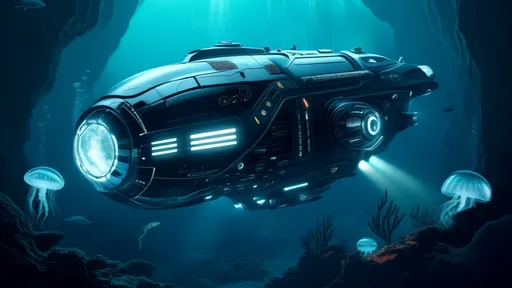
The implications for deep-sea navigation are profound. A quantum gyroscope could provide continuous, drift-free orientation data, allowing an AUV to maintain an accurate position over long durations without external references. This capability is particularly valuable in the deep ocean, where GPS signals cannot penetrate and acoustic beacons are impractical. With quantum gyroscopes, underwater vehicles could explore previously inaccessible regions, from deep-sea trenches to under-ice environments, with unparalleled precision.
Overcoming the Challenges of Quantum Technology
Despite their promise, quantum gyroscopes are not without challenges. The technology requires extremely stable conditions to function, as even minor vibrations or temperature fluctuations can disrupt the delicate quantum states. Engineers are working on ruggedized designs that can withstand the harsh conditions of the deep sea, including high pressure and corrosive saltwater. Advances in miniaturization and power efficiency are also critical, as AUVs have limited space and energy resources.
Another hurdle is cost. Quantum sensors are currently expensive to produce, though prices are expected to drop as the technology matures and scales. Researchers are optimistic that within the next decade, quantum gyroscopes could become a standard feature on advanced underwater vehicles, enabling new scientific discoveries and industrial applications.
Applications Beyond Exploration
The potential uses for quantum gyroscope-equipped AUVs extend far beyond scientific research. The oil and gas industry, for instance, could employ these vehicles for precise pipeline inspections in deepwater fields. Military applications include stealthy underwater reconnaissance and mine detection, where GPS-denied navigation is essential. Even the burgeoning field of underwater robotics for aquaculture and marine conservation could benefit from more reliable navigation systems.
Moreover, the lessons learned from developing quantum gyroscopes for underwater use could spill over into other domains. Similar technology might one day enable navigation in other GPS-denied environments, such as underground or in deep space. The fusion of quantum physics and engineering is opening doors to a new era of autonomous navigation, unshackled from the limitations of satellite signals.
The Future of Deep-Sea Navigation
As quantum gyroscopes move from laboratory prototypes to real-world deployments, the future of deep-sea exploration looks brighter than ever. Researchers envision fleets of autonomous vehicles mapping the ocean floor with centimeter-level accuracy, uncovering geological and biological mysteries that have eluded us for centuries. The ability to navigate without satellites could also enhance disaster response, allowing AUVs to operate in conditions where surface ships or satellites are unavailable, such as during severe storms or in polar regions.
The journey from theoretical concept to practical tool has been long, but the payoff promises to be transformative. Quantum gyroscopes represent more than just a technical innovation—they are a key to unlocking the final frontier on Earth. With this technology, the ocean's depths may soon become as navigable as its surface, ushering in a new age of underwater discovery and innovation.
By /Jul 18, 2025
By /Jul 18, 2025
By /Jul 18, 2025
By /Jul 18, 2025

By /Jul 10, 2025

By /Jul 10, 2025
By /Jul 18, 2025
By /Jul 18, 2025
By /Jul 18, 2025

By /Jul 18, 2025
By /Jul 9, 2025
By /Jul 9, 2025

By /Jul 18, 2025

By /Jul 18, 2025

By /Jul 18, 2025

By /Jul 18, 2025

By /Jul 18, 2025
By /Jul 18, 2025
By /Jul 18, 2025
By /Jul 9, 2025