The Arctic's frozen vaults are cracking open, and scientists are racing to understand the consequences. For millennia, vast stores of organic matter have been locked away in permafrost—ground that remains frozen for at least two consecutive years. Now, as global temperatures rise, this icy stronghold is giving way, releasing ancient carbon into the atmosphere in the form of methane, a greenhouse gas with a warming potential 28 times greater than carbon dioxide over a 100-year timescale.
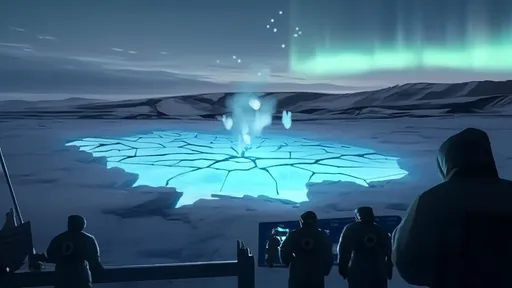
This phenomenon has been dubbed the "methane time bomb," a ticking climate threat buried beneath the northern latitudes. Unlike gradual carbon dioxide emissions from fossil fuels, methane bursts from thawing permafrost could trigger nonlinear climate feedback loops—self-reinforcing cycles that accelerate warming beyond current projections. Recent field studies in Siberia and Alaska reveal methane hotspots where the ground literally bubbles with escaping gas, painting an eerie picture of landscapes breathing their long-held carbon back into the atmosphere.
The mechanics of this release are as fascinating as they are alarming. When permafrost thaws, previously frozen organic material—dead plants and animals that accumulated over thousands of years—becomes food for microbes. In waterlogged conditions, these microorganisms produce methane through anaerobic decomposition. The rate of this process depends on multiple factors: the depth of thaw, soil composition, moisture levels, and even the types of vegetation that colonize the newly thawed ground. Some areas become methane factories, while others may see increased carbon dioxide production instead.
What keeps climate scientists awake at night is the potential for abrupt, large-scale releases. Thermokarst lakes, formed when ice-rich permafrost melts and the ground collapses, are particularly efficient methane emitters. As these lakes expand, they expose ever more permafrost to thawing, creating a self-perpetuating cycle. Satellite imagery shows these water bodies proliferating across northern landscapes, their dark surfaces absorbing more solar heat than reflective snow and ice, further accelerating local warming.
The modeling challenges are immense. Current climate models struggle to capture the fine-scale heterogeneity of permafrost landscapes—a patchwork of bogs, forests, and tundra that responds unevenly to warming. Newer generations of models incorporate microbial activity, hydrological changes, and even the insulating effects of winter snowpack. Yet even these advanced simulations may be underestimating the speed of methane release, as field observations consistently outpace predictions.
Historical context adds another layer of concern. Paleoclimate records suggest that during past warming periods, methane releases from wetlands (including thawing permafrost) contributed significantly to global temperature increases. The difference today is the unprecedented rate of human-caused warming, which may push these systems beyond their natural buffering capacity. While ancient warming unfolded over millennia, we're seeing comparable temperature rises in mere decades—potentially overwhelming the Arctic's ability to adjust gradually.
Indigenous communities in the far north are witnessing these changes firsthand. Hunters report unfamiliar land surfaces giving way beneath their feet, while coastal villages confront "drunken forests"—trees tilting wildly as the frozen ground beneath them destabilizes. These observations provide ground-truth data that complements scientific measurements, painting a holistic picture of a landscape in rapid transition.
The geopolitical implications are equally profound. As permafrost thaws, it's not just releasing methane—it's altering entire ecosystems and infrastructure. Roads buckle, pipelines destabilize, and storage facilities risk compromise. Meanwhile, the specter of massive methane releases complicates international climate agreements, as natural emissions could undermine even aggressive human emission reduction targets.
Mitigation strategies remain controversial. Some researchers propose large-scale interventions like introducing methane-eating bacteria to thaw zones or flooding areas to create oxygen-poor environments that limit microbial methane production. Others warn that such geoengineering attempts could have unintended consequences in delicate Arctic ecosystems. The more conservative approach—dramatically reducing human greenhouse gas emissions to slow permafrost thaw—remains the safest path, yet global emissions continue to rise.
As scientific expeditions drill deeper into permafrost cores and deploy increasingly sophisticated sensors, one thing becomes clear: the methane time bomb's fuse is already burning. The question isn't whether it will go off, but how intensely, and whether humanity can muster the collective will to defuse it before the worst-case scenarios become inevitable. The frozen north, long a silent sentinel of planetary health, is now sounding an unmistakable alarm.
By /Jul 18, 2025
By /Jul 18, 2025
By /Jul 18, 2025

By /Jul 18, 2025
By /Jul 10, 2025
By /Jul 10, 2025

By /Jul 18, 2025
By /Jul 18, 2025
By /Jul 18, 2025
By /Jul 18, 2025
By /Jul 9, 2025
By /Jul 9, 2025
By /Jul 18, 2025
By /Jul 18, 2025
By /Jul 18, 2025
By /Jul 18, 2025

By /Jul 18, 2025
By /Jul 18, 2025
By /Jul 18, 2025
By /Jul 9, 2025